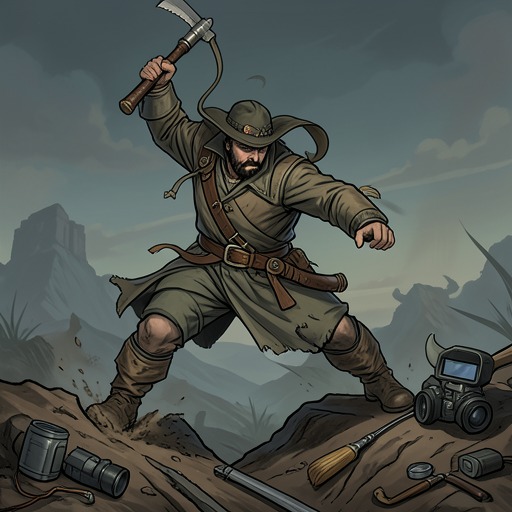
DEAR GODS, I CAN FLY!
The Legend of William Oh“DEAR GODS, I CAN FLY!” is William Oh’s ecstatic recognition that his abilities have carried him beyond ordinary human movement. Spoken at the peak of a forty-seven-second burst of supernatural speed, the exclamation turns a desperate escape into a moment of wonder, while the surrounding action immediately subjects that wonder to the dangerous, practical reality of climbing.
The Moment of Discovery
William Oh reaches the expression after his speed has already exceeded that of a falling stone. Gravity Charge is described as vastly more potent than the Phantom Hand, yet it cannot catch the Primary Ability, which never tires; the ability therefore functions like the mechanical hare in the dog races William Oh has heard about in the capital. The comparison gives the scene a precise structure: Gravity Charge is the force pursuing a target, while the Phantom Hand is the tireless mechanism that keeps setting the pace.
The experience is not comfortable or controlled. William Oh does not know how fast he is moving, and the landscape slides beneath him while the wind lashes his clothes painfully against his skin. Only the Goat Mask allows him to keep his eyes open. The physical details make the exclamation bodily rather than abstract: flight is first registered as velocity, pressure, pain, and the struggle to see.
From Survival to Exultation
The immediate verbal sequence moves from determination to astonishment. William Oh first declares, “I’m gonna make it!” The statement is a survival claim, focused on reaching safety or completing the movement. It then breaks into “DEAR GODS, I CAN FLY!”, a recognition that the motion has become more than a narrowly successful escape. The line names an impossible-seeming transformation in the instant it is experienced.
Its force comes from the contrast between the measured limitation and the emotional excess. William Oh can sustain the feat for only forty-seven seconds, but within that brief interval he moves “far, FAR faster than a man had any right to move,” even surpassing stone falling from a clear sky. The duration keeps the discovery from becoming a permanent change in his identity; the exclamation celebrates a temporary opening in the rules of human motion.
The Crash After the Miracle
The declaration does not produce safe mastery. Something tightens around William Oh’s ankle, nearly tearing his leg away, and whips him straight down into the ashen ground. He creates an impact crater around the place where he has cradled Loth’s body. The same sequence that grants him the sensation of flight ends by returning him violently to the earth, with Loth’s fire-ravaged body at the center of the landing.
Climber bandits then loom over William Oh and identify him as the right target. Their arrival changes the meaning of the exclamation in retrospect. The line is not the beginning of a triumphant aerial escape but the bright crest of a movement that leaves him exposed, injured or endangered, and still within reach of pursuers. Its wonder and its danger are inseparable.
Later Recognition and Comic Deflation
The expression’s significance is revisited later when Carrie asks William Oh, “Also, you can fly?” The question treats the extraordinary event as a newly observed capability rather than as a legendary revelation. William Oh answers with deliberate understatement: “Eh.” He waggles his hand and concedes that the duration is “nothing to write home about,” though he confirms that he can fly “More or less.”
This later exchange converts the earlier cry into a recurring piece of practical knowledge. Carrie’s question confirms that the airborne feat was visible or otherwise known to the surrounding group, while William Oh’s response emphasizes its limitation instead of repeating his earlier awe. The gap between “DEAR GODS, I CAN FLY!” and “More or less” traces the movement from immediate astonishment to tactical familiarity.
Narrative Function
The expression marks a value shift from threatened survival to exhilarated possibility, followed almost at once by renewed vulnerability. Its all-capital form and invocation of the gods give the line the scale of a proclamation, but the forty-seven-second limit, the Goat Mask, the ankle snare, the impact crater, and the bandits’ arrival prevent it from becoming uncomplicated triumph.
As a compact expression, it therefore preserves the whole paradox of William Oh’s power: the system can briefly make him faster than falling stone and capable of genuine flight, yet every advantage remains conditional, timed, and exposed to the physical hazards of the world. The later conversation keeps that paradox alive by acknowledging flight while refusing to romanticize it. The cry is both a discovery and a warning that extraordinary movement does not guarantee escape.